
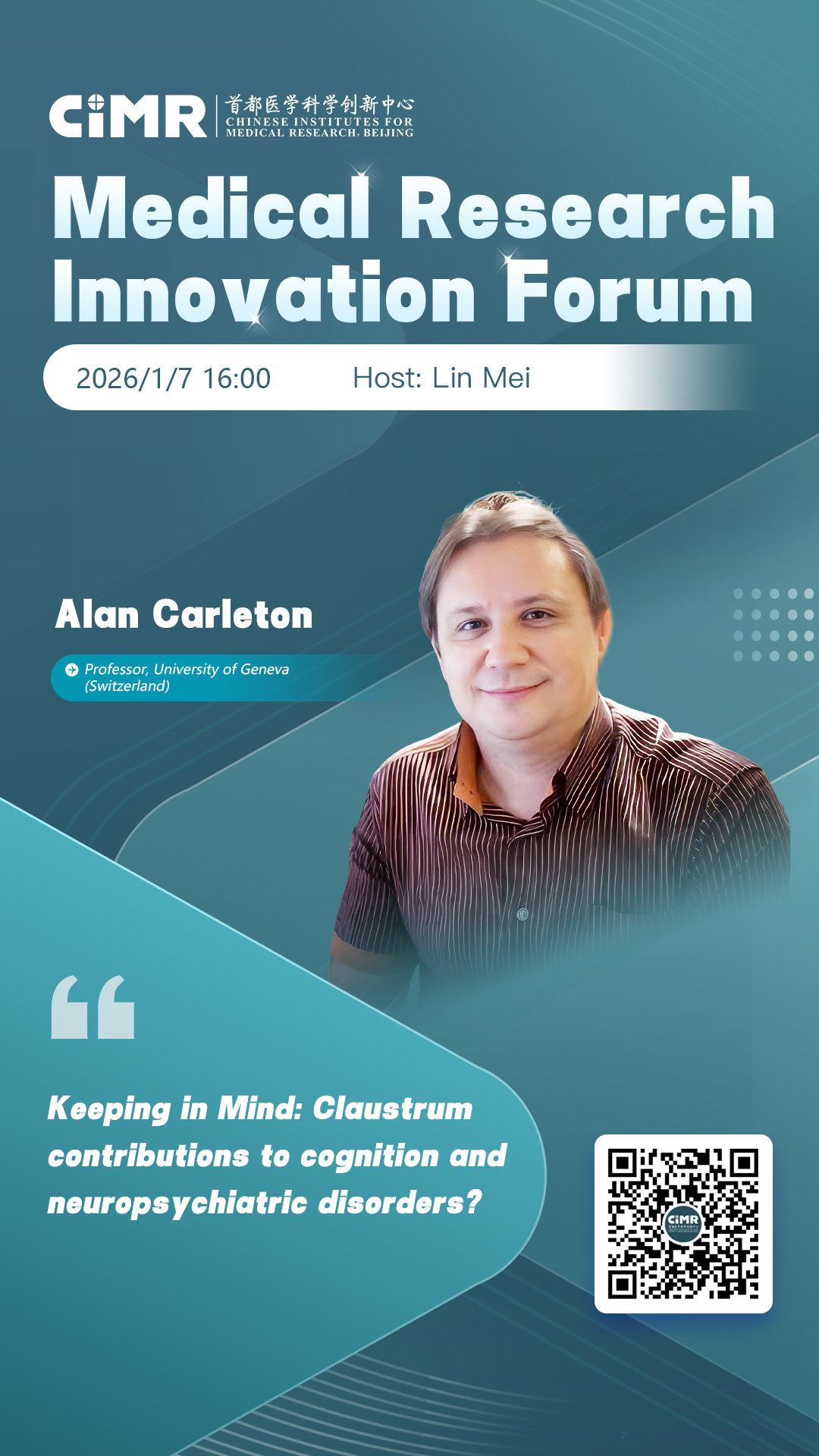
医学创新论坛第92期
时间:2026年1月7日(周三)下午16:00
地点:首都医科大学基础科研楼北楼二层多功能厅
主持人:
梅林
首都医学科学创新中心
报告人:
Alan Carleton
教授
瑞士日内瓦大学
报告题目:
Keeping in Mind: Claustrum contributions to cognition and neuropsychiatric disorders?
摘要:
The claustrum is a thin, evolutionarily conserved telencephalic nucleus distinguished by exceptionally dense and widespread reciprocal cortical connectivity. Despite long-standing hypotheses implicating the claustrum in sensory integration and consciousness, its contribution to cognition has remained poorly defined, largely due to technical challenges in targeting claustral circuits with cellular specificity. In this talk, I will present evidence supporting a central role for the claustrum in higher cognitive function, with a particular emphasis on working memory (WM). Using cell-type–specific circuit mapping, functional manipulations, and behavioral assays in mice, we show that claustral neurons are recruited during information encoding and remain persistently active throughout the maintenance phase of WM tasks, sustaining task-relevant information for tens of seconds prior to decision making. Transient disruption of claustral activity during encoding, delay, or comparison epochs robustly impairs performance in delayed non-match–to-sample paradigms, indicating a causal contribution of the claustrum to WM processing that extends beyond sensory encoding or motor execution. At the molecular level, we identify the neurodevelopmental disorder risk gene encoding the transcription factor NR4A2/NURR1 as a key regulator of claustral neuron identity and function. Integrated transcriptomic and physiological analyses reveal that NR4A2 haploinsufficiency alters gene expression programs and intrinsic excitability in claustral neurons, resulting in WM deficits and broader cognitive dysfunction in mouse models relevant to neurodevelopmental disorders, including autism and schizophrenia. Together, these findings position the claustrum as a critical hub for cognitive control, linking molecular specification, circuit dynamics, and behavior. We propose that claustral dysfunction represents a convergent mechanism underlying WM impairments across neuropsychiatric disease states, highlighting the claustrum as a previously underappreciated target for understanding—and potentially treating—cognitive dysfunction.
代表性论文:
1. Marissal T, Salazar RF, Bertollini C, Mutel S, De Roo M, Rodriguez I, Müller D, Carleton A. Restoring wild-type-like CA1 network dynamics and behavior during adulthood in a mouse model of schizophrenia. Nat Neurosci. 2018 Oct; 21(10): 1412-1420.
3. Bhattacharjee, A. S., Huber, C., Unsal, B., Renfer, J. R., Rodriguez, I., & Carleton, A. (2024). The claustrum is critical for maintaining working memory information. bioRxiv, 2024: 2024.10. 28.620649.


 北京市丰台区右安门外西头条10号
 010-86738999
 cimr@cimrbj.ac.cn








 En
En

